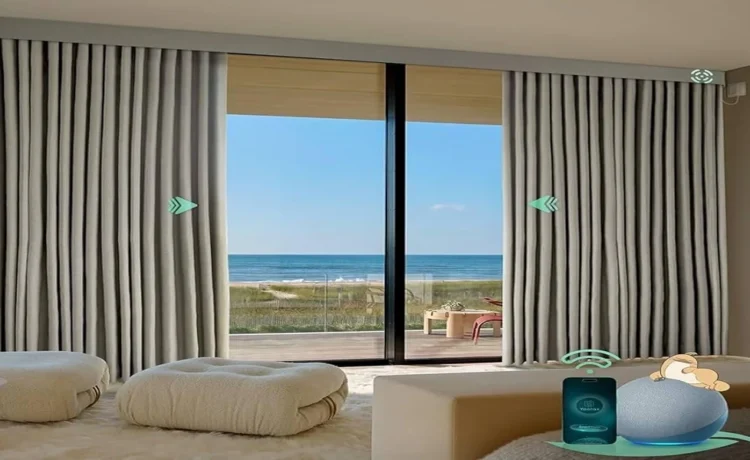
Tap a phone screen in a taxi and, across town, a living room dims. It looks like magic and is sold as such. In truth a smart curtain is an ordinary curtain attached to a chain of quite ordinary parts, and the chain is only as dependable as its weakest link. Tracing one command from fingertip to fabric is the clearest way to see what you are buying for a flat, a boardroom or a clinic.
Link One: The Command
Every movement starts with an instruction, and there are more ways to give one than most buyers realise. A handheld remote. A wall switch beside the light switches. A phone app. A spoken request to a voice assistant. A timer set for sunrise. A sensor that reacts to brightness. A sensible installation offers at least two of these, so that guests, children and anyone who has mislaid a phone can still open the curtains.
Link Two: The Messenger
The instruction must reach the motor. Simple systems use a radio remote that talks to the motor directly and works without internet. Connected systems pass the message through the home’s wireless network or a small hub, which is what allows control from outside the house and grouping with lights or air-conditioning. Ask which method is used. If everything depends on a cloud service, find out what still functions when the router is down.
Link Three: The Motor
At one end of the track sits a slim tubular or box motor. Its job is modest: turn a pulley. Good units start and stop gently so the fabric does not jerk, run quietly enough not to wake a sleeper, and sense an obstruction instead of straining against it. Most are mains powered. Rechargeable battery motors exist for places where no socket can be provided, at the price of periodic charging.
Link Four: Belt, Carriers and Track
Inside the rail a toothed belt loops from the motor to a pulley at the far end. Carriers clipped to the belt haul the leading edge of the curtain; the remaining carriers follow. This is why a motorised curtain track system is supplied as a set, cut to the exact width of the wall. The track can usually be bent for bay windows or corners, though each bend adds friction and should be planned with the fitter, not improvised.
Link Five: The Cloth Itself
The fabric is the load. Heavy lined drapes across a wide span need a motor rated for the weight; sheers barely trouble it. Wave or ripple headings suit automation because the carriers are already linked and move as a train. Pinch pleats work too. What matters is that the curtain is made for the track, with the correct hooks and fullness, so the motor is not dragging bunched cloth against a wall or a sofa.
The Link People Forget: Power
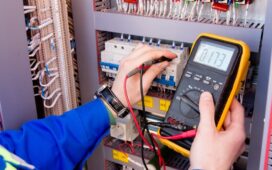
Nothing happens without electricity at the motor end. In a renovation this means telling the electrician early, so a concealed point can be placed inside the pelmet or curtain pocket. In a finished room, surface trunking or a battery motor may be the only options. Offices should check whether the landlord’s fit-out rules require a licensed electrician for the connection. This single decision causes more delay than any choice of fabric.
When a Link Breaks
Ask what happens in a power cut. Many tracks allow the curtain to be drawn by hand when the motor is unpowered, and some start the motor when the fabric is tugged lightly. Others lock. A manual override is worth insisting on for bedrooms and for any room that serves as an escape route. Ask also how limits are reset if the curtain stops short, and whether that needs a technician.
Homes: Routines Worth Having
In a flat the useful automations are plain ones. Bedroom curtains that part slowly at a set hour make waking easier than an alarm in the dark. West-facing drapes that close in mid-afternoon keep the room cooler before anyone returns from work. A single evening scene can shut every curtain and switch on lamps. Curtains that open and close while the family is away also make the home look occupied.
Offices: Fewer Hands on the Fabric
Workplaces gain different things. A meeting room with tall glazing can darken for a presentation from the same panel that lowers the screen. Reception curtains follow a timetable instead of relying on whoever arrives first. Because nobody pulls the cloth by hand, it stays cleaner and the heading lasts longer. Facilities staff should hold the remotes’ pairing instructions and a spare handset, since lost controllers are the commonest support call.
Checking the Chain Before You Pay
Walk the five links with any supplier: how commands are given, how they travel, what motor is fitted and its noise, how the track is built, and whether the curtain is made to match. Add the two forgotten ones, power and override. Request a demonstration on a full-length track, not a tabletop sample. If each link has a clear answer and a warranty behind it, a smart curtain will be a quiet convenience instead of a gadget that needs coaxing.