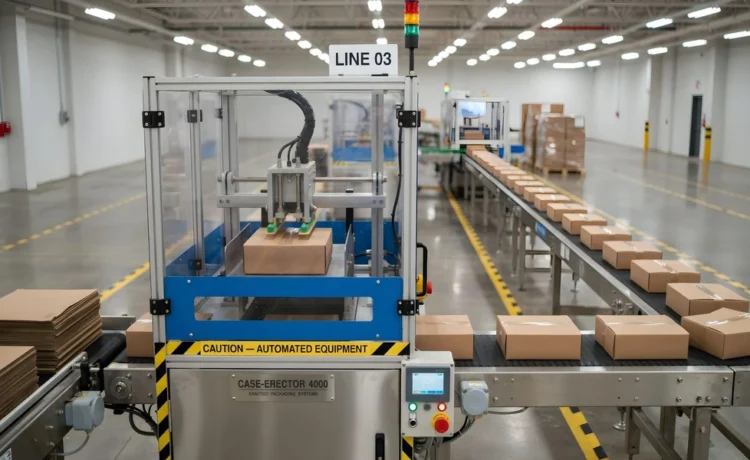
Fulfilment managers usually arrive at this decision through a labour calculation: packers cost a certain amount per hour, a machine costs a certain amount once, and the payback period follows. That arithmetic is sound as far as it goes and it leaves out most of what determines whether automation actually works for a given operation. Volume consistency, carton variety, and what happens when the machine stops all affect the outcome more than the hourly rate comparison suggests. Three trade-offs cover what matters when evaluating a carton erector in Singapore alongside sealing equipment.
1. Labour Cost Against Volume Consistency
Manual packing scales smoothly with demand. A quiet week needs fewer people; a peak needs more, and temporary staff can be brought in. The cost tracks volume reasonably closely.
Automation does not scale that way. The capital cost is fixed regardless of throughput, which means the economics depend heavily on running the equipment consistently. An operation with sharp seasonal peaks and quiet periods in between gets a worse return than one with steady year-round volume, even at the same annual total.
The useful figure is not peak daily throughput but how many hours the equipment would actually run across a year. Equipment sitting idle for months still carries its cost, and a manual operation flexing with demand sometimes works out better for a business with pronounced seasonality.
2. Carton Variety and What Changeover Actually Costs
Automated erectors and sealers handle a defined range of carton sizes, and changing between them takes time and sometimes adjustment.
An operation shipping two or three standard carton sizes suits automation well. One shipping a dozen sizes, or frequently changing between them within a shift, loses a substantial portion of the throughput advantage to changeover. Fulfilment operations considering a carton sealer in Singapore alongside an erector should map their actual carton mix by volume before specifying, since a machine optimised for the most common size handles eighty percent of volume efficiently while the remainder may still need manual handling, and that hybrid reality is often the practical outcome rather than full automation.
Ask suppliers directly how many sizes a machine handles without adjustment, how long a changeover takes, and who performs it.
3. Reliability, Maintenance, and What Happens When It Stops
Manual packing degrades gracefully. If someone is absent, output drops proportionally. If a machine stops, the line stops entirely, and in a single-line operation that means shipping stops until it is fixed.
This changes what the operation needs: spare parts on site, someone able to clear a jam or make a basic adjustment, and a support arrangement with a response time that matches your shipping commitments. Those are ongoing costs and capabilities that rarely appear in a payback calculation.
Ask what the expected maintenance schedule is, what consumables the equipment uses, what the common stoppage causes are, and what support response the supplier commits to.
Modelling the Decision on Your Own Figures
The comparison becomes meaningful with real data: cartons shipped per day across a full year including peaks and troughs, the carton size mix by volume, current labour hours spent on erecting and sealing specifically, and available floor space.
With that, a supplier can model throughput and payback against your operation rather than a general case. It is also worth considering a staged approach, automating erecting first while sealing remains manual or the reverse, since that lowers the initial commitment and reveals how well automation suits your volume pattern before the full investment is made.
Contact Sunstream Industries to model automation against your carton mix, volume pattern, and current packing labour.